
Leave the conversation to find the context
- Open the KNWN Visibility dashboard.
- Select the correct site and report.
- Find the relevant gap, question, page, or strategy.
- Carry that context back into the working conversation.
KNWN VISIBILITY MCP CASE STUDY
KNWN Visibility is our AI visibility platform. We built a focused, read-only MCP server so users can ask for visibility summaries, gaps, questions, recommendations, and strategies without leaving their AI workflow.
get_visibility_gaps
The MCP chooses the focused product tool and checks access to the requested site.
THE PRODUCT OPPORTUNITY
KNWN Visibility already tracks brand visibility, prompts, citations, gaps, recommendations, and saved strategies. The dashboard is where users explore the full product, but it is not where every question begins.
A marketer planning content in ChatGPT might want a quick visibility summary. A founder might want to see where competitors appear instead. A content lead might need the next questions or page recommendations without stopping the conversation to search through several screens.
We wanted those answers to come from KNWN Visibility itself. The MCP makes selected product workflows available inside an AI client while the dashboard, API, permissions, and business rules remain the source of truth.
The MCP is not a second version of KNWN Visibility. It is a new way to use the product.
WORKING EVIDENCE
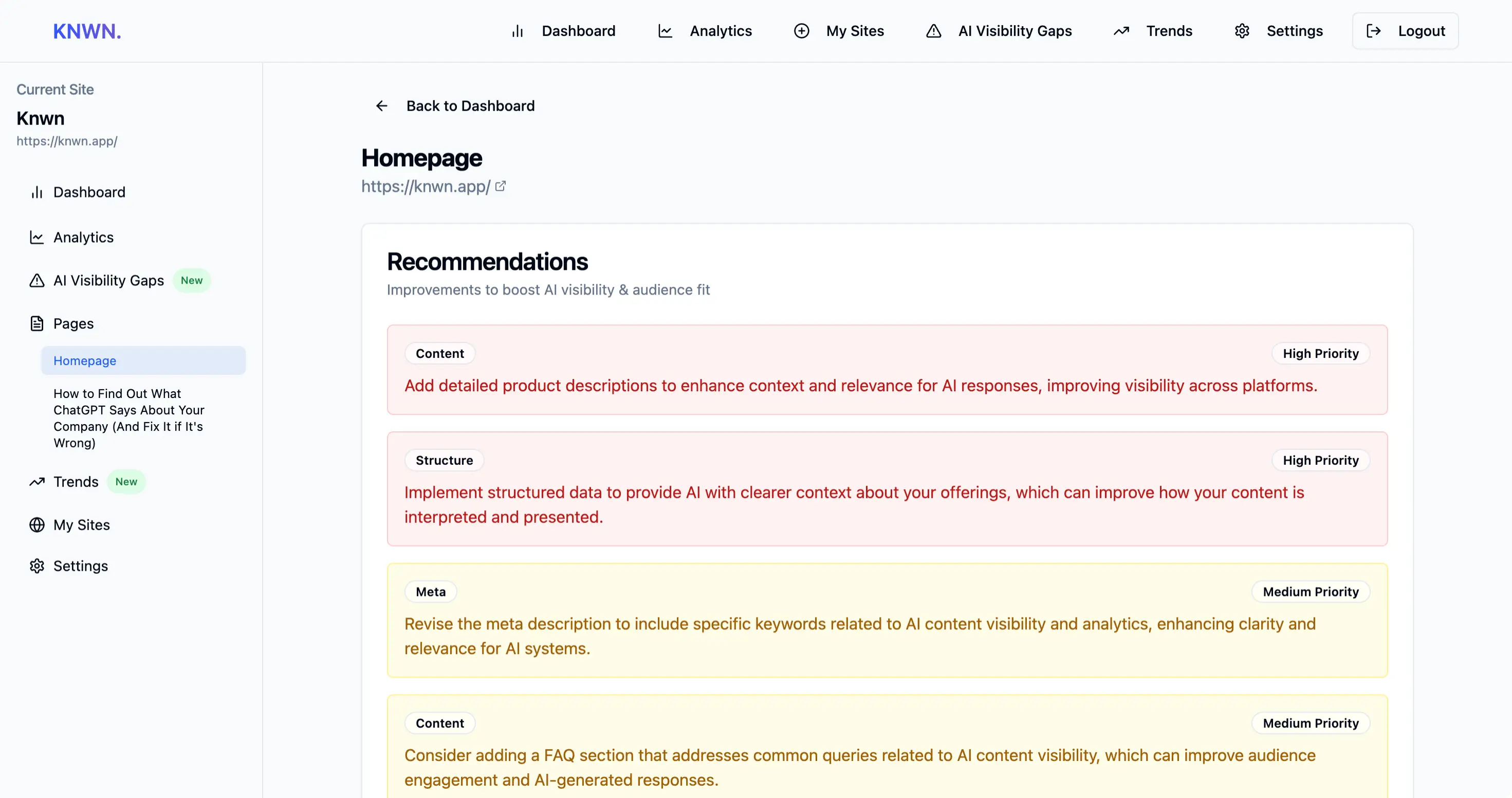
BEFORE AND AFTER
The MCP does not replace the dashboard. It removes unnecessary navigation when the user already knows the question they need answered.
WHAT USERS CAN ASK
The user does not need to know a tool name. They ask about visibility, gaps, questions, pages, or strategy and receive data from the KNWN Visibility account they are allowed to access.
Returns the selected site's current visibility summary and recent direction from KNWN Visibility.
get_visibility_overview
Surfaces the gaps that matter for a site the user is already authorized to access.
get_visibility_gaps
Finds relevant questions that can become new content or product-positioning opportunities.
get_trending_questions
Returns page recommendations after confirming that the page belongs to the selected site.
get_page_recommendations
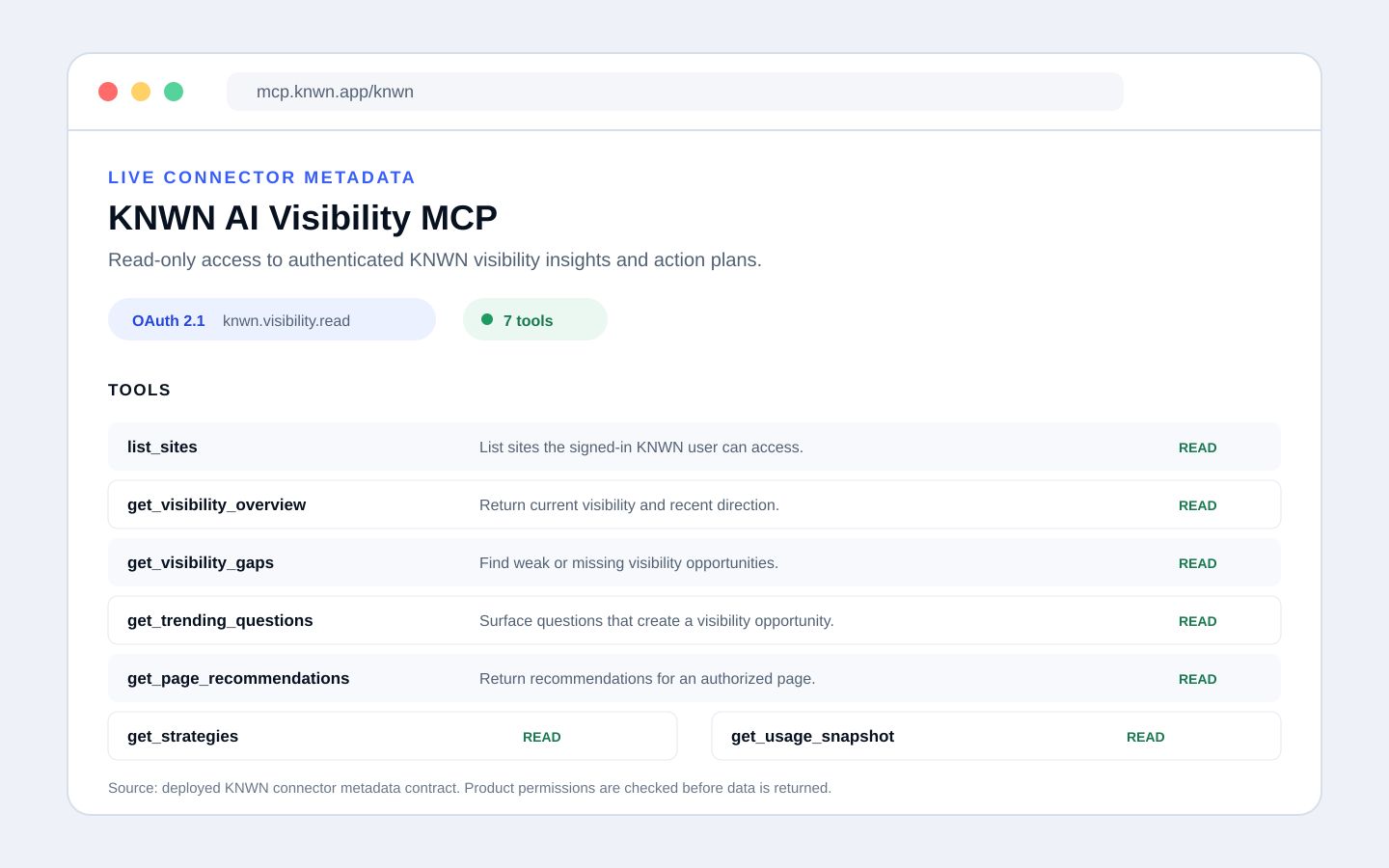
THE TOOL SURFACE
We deliberately did not mirror the full API. The launch surface covers a small set of useful questions while keeping risky or inconsistent operations out.
| Tool | What it does |
|---|---|
list_sites | Show the KNWN Visibility sites the signed-in user can access. |
get_visibility_overview | Return a site's current visibility summary and recent direction. |
get_visibility_gaps | Find weak or missing visibility opportunities for an authorized site. |
get_trending_questions | Surface questions that create a relevant visibility opportunity. |
get_page_recommendations | Return recommendations for a page that belongs to the selected site. |
get_strategies | Read the user's saved KNWN Visibility action plans and their status. |
get_usage_snapshot | Show how the MCP is being used and where requests encounter friction. |
HOW IT WORKS
KNWN Visibility remains responsible for identity, tenant access, object ownership, and product data. The MCP handles the AI-facing tool contract and request flow.
The account-linking flow keeps the AI-client token separate from the KNWN Visibility product credential. Product access stays server-side.
Every site and page request is checked against the signed-in user's existing KNWN Visibility access before data is returned.
The MCP can retrieve insights and recommendations, but it cannot publish, spend credits, enqueue jobs, or change account data.
The user connects their KNWN Visibility account to a compatible AI client.
The client calls one focused MCP tool with the requested site or page.
The MCP verifies scope and confirms that the user can access the requested object.
The KNWN Visibility API returns only the permitted data needed for the answer.
Current availability: the public MCP demo and seven-tool server are live. Customer account linking remains in controlled rollout while we complete the production OAuth configuration.
OBSERVABILITY
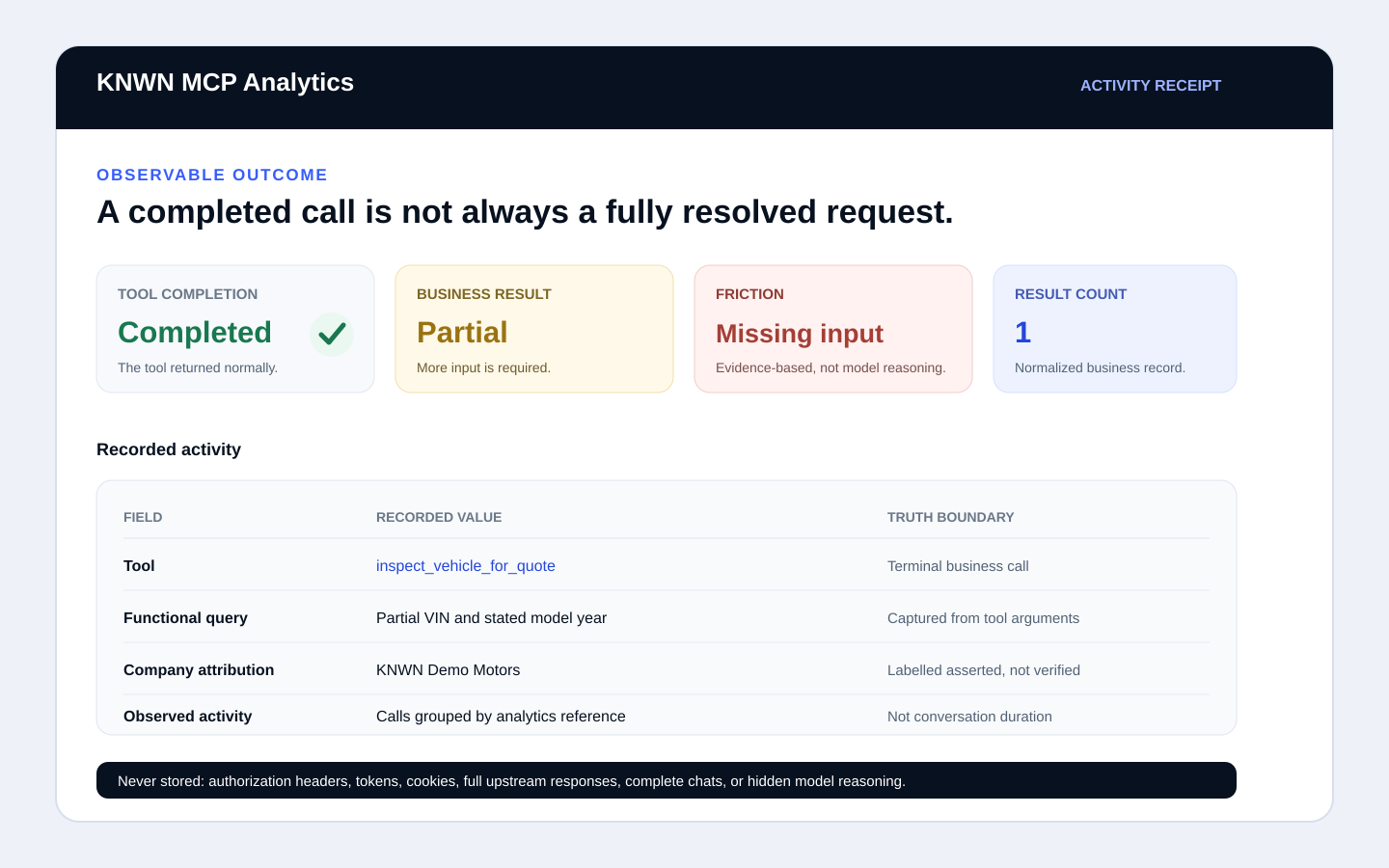
The analytics layer helps us see which tools people use, where requests slow down, and whether a technically successful call actually resolved the task.
WHAT WE LEARNED
Building the MCP against a product we operate made the trade-offs concrete. The same lessons apply to any SaaS product that wants to become useful inside AI clients.
The useful tool surface was not a copy of the KNWN Visibility API. It was a small set of product questions users already need answered.
Identity, account access, site ownership, page ownership, and business rules remain inside KNWN Visibility rather than being recreated in the MCP.
A narrow read surface is easier to test, explain, monitor, and trust before introducing any operation that changes data or spends credits.
Our analytics separates a technically successful tool call from an answer that actually resolved the user's request.
FAQ
KNWN Visibility is the AI visibility platform built and operated by KNWN. It tracks how brands appear in AI answers, the prompts and citations shaping that visibility, competitive gaps, and recommended actions.
A connected user can list their KNWN Visibility sites, retrieve a visibility overview, inspect gaps, find trending questions, request page recommendations, read saved strategies, and review MCP usage.
No. The dashboard remains the complete product experience. The MCP is a faster conversational route into selected product workflows when a user is already working inside ChatGPT or another compatible AI client.
No. The current tool surface is intentionally read-only. It does not publish content, spend credits, start background jobs, or modify KNWN Visibility records.
The MCP uses KNWN Visibility's existing account and object permissions. Every site or page request is checked before product data is returned, and the connector does not access the product database directly.
Yes. We design the tool surface, authentication, tenant checks, write boundaries, analytics, deployment, and handover around the product's real workflows and existing permission model.
BRING YOUR PRODUCT INTO AI WORKFLOWS
Show us the product, the account model, and the questions or actions that matter. We will design the smallest MCP surface that makes those workflows useful, secure, and operable.