
AI agents can already check out on Shopify, Microsoft Copilot, Google and now WhatsApp, and shoppers are close to letting them. When an agent does the buying, being recommended won't be enough. It has to read your prices and stock correctly and get through your checkout.
TL;DR
- Shoppers already use AI to shop, and the checkout for agents is built. Amazon says 350 million customers used Alexa for Shopping in the past year, and in twelve months Microsoft, Google, Meta and Shopify all shipped ways for an agent to complete a purchase. What hasn't happened yet is shoppers letting the agent pay.
- This holiday season is the first real test. Meta's Muse put a paying agent inside WhatsApp and reached No. 1 on the US App Store within ten days of launch. We expect shoppers to hand over the purchase one use case at a time, starting with reorders and gifts, and company results should show it by mid-February.
- Getting bought takes different prep than getting recommended. Being named in AI answers doesn't mean an agent can read your prices and stock accurately or get through your checkout. In our test of 400 AI shopping attempts, the brands an AI recommended were not reliably the brands it bought.
At KNWN we believe AI agents will become the next biggest consumer for most ecommerce brands: software that researches, compares and buys on a shopper's behalf. This piece looks at how far agent shopping has come and where it's going. Most brands getting ready for AI are working on being recommended, assuming that if an assistant recommends them, an agent will buy from them. We tested that assumption, and it doesn't hold.
Where AI shopping is now
Shoppers are already used to asking AI for help when shopping. Amazon says 350 million customers used Alexa for Shopping in the past 12 months, a count that covers the period when it was still called Rufus. Walmart's CEO, John Furner, said in August that the number of customers using its Sparky assistant was up 70% on last year, and Shopify's president said AI-driven orders to its stores tripled in a year.
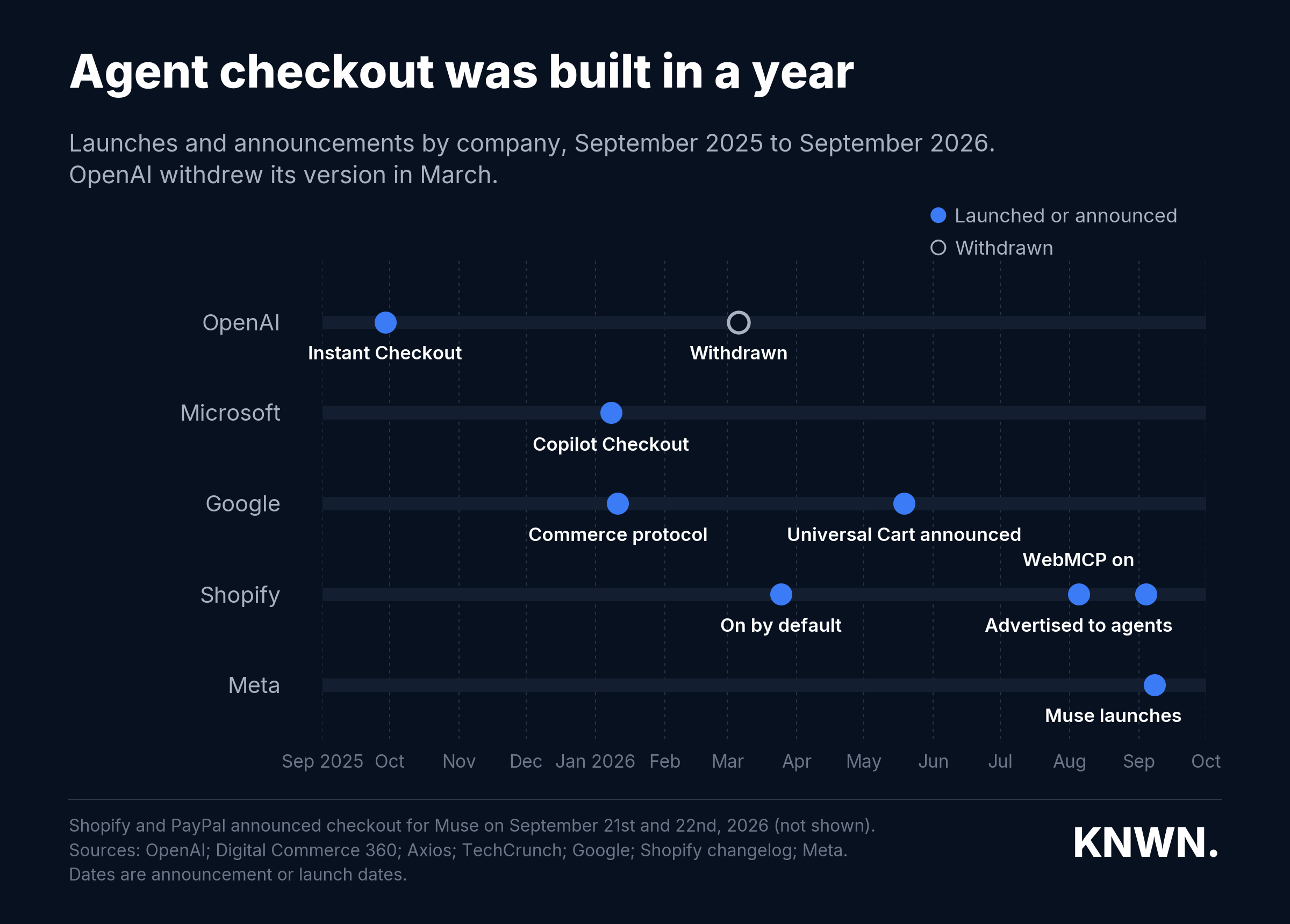
The checkout for agents is built. Shopify made agentic storefronts the default in March. In August it added support for WebMCP, a proposed web standard that lets agents use a store inside the browser, and on September 4th it began advertising every storefront to AI agents automatically.
The other big platforms built their own routes in the same year. Microsoft launched Copilot Checkout on January 8th, and three days later Google announced the Universal Commerce Protocol, an open standard for agents to shop across stores. Meta's Muse arrived on September 8th with Stripe's Link checkout built in, and within two weeks Shopify and PayPal had announced deals to bring their agentic checkout experiences into it as well.
Shoppers letting the AI agent pay is still emerging. Forrester surveyed online adults in the US, UK and Canada and found three in four uncomfortable letting an agent complete a purchase and pay on its own, even with spending limits set in advance. Muse, the newest paying agent, has an estimated 560,000 to 700,000 daily users, against the 3.6 billion people who use Meta's apps each day. Shopify's president said in August that "it is early and the volume relative to $116 billion GMV is small."
Where it's going
We think this Q4 is different in one way: people can now go through the full shopping journey with AI agents in places they already frequent.
Until now, AI shopping assistants such as Alexa for Shopping and Sparky have helped people decide, and the person still made the final pick.
Muse, however, takes the next step: one agent, inside WhatsApp, that shops across many stores, can make decisions and can pay. At its Connect event on September 23rd Meta named retail partners including Gap, Sephora, DICK'S Sporting Goods, American Eagle, Instacart and Expedia.
People are trying it, and fast. Muse has held No. 1 on the US App Store since September 18th and on Google Play since September 19th, and its downloads grew 55% a day on average in its first ten days. We read it as a first version, and Meta has the reach to improve it quickly.
We think this holiday season will be the first in which enough shoppers let an agent finish a purchase for the platforms to report it. It won't happen all at once. We expect agents to spread one use case at a time, starting with purchases where the shopper already knows the need and the budget, such as a reorder or a gift. That is a narrower view than the companies selling agent checkout. Visa has said it expects "millions" of consumers to be using agent payments by the holidays. Company results should show which view is right by mid-February.
How fast could it move?
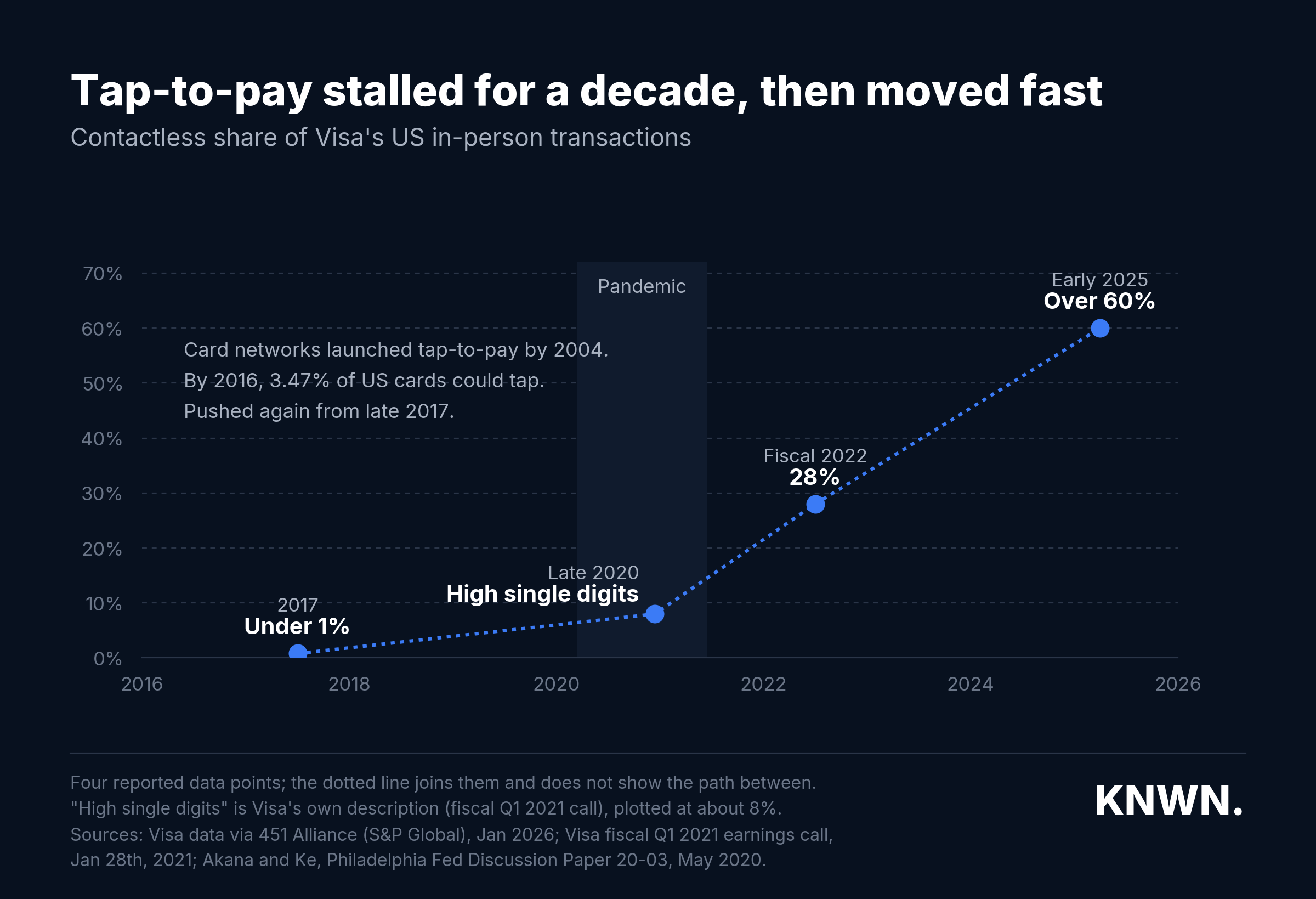
Payment habits have changed quickly before, though rarely in a single season, and usually once the option was already in people's hands. Card networks had launched tap-to-pay by 2004, and by 2016 only 3.47% of US cards could tap, according to a Philadelphia Fed discussion paper. After networks and banks pushed it again from late 2017, contactless grew from under 1% of Visa's US in-person transactions to 28% by fiscal 2022 and more than 60% by 2025, according to Visa's own data.
Shopify switching agent checkout on by default is the same kind of push: the option is in place before most shoppers ask for it. The first signs to watch for are Shopify or Meta reporting agent orders as a number and Visa publishing an agent transaction count.
Getting bought takes different prep than getting recommended
The first step, shoppers asking AI for help, is the one brands have prepared for: being cited, described well and named in an assistant's answers. That work matters while a person reads the list and makes the choice. When an agent makes the choice and pays, it also has to read the right price, stock and variant, get through checkout, and be let into the store in the first place.
That part is harder than it looks. At KNWN, we tested whether being recommended carries over into being bought. We gave an AI the same shopping task two ways: recommend the best options, or pick one and put it in a cart to buy. Across 400 shopping attempts in 20 purchase scenarios, the brands the AI recommended were not reliably the brands it put in the cart. More about that is coming as the study is released over the next month.
Get the findings
The study publishes in parts starting October 6th, covering both modes across all 20 scenarios with the full method.
Sources
| Figure or claim | Population | Source, date | Class |
|---|---|---|---|
| Agentic storefronts default (Mar), WebMCP default (Aug 5th), storefronts advertised to agents (Sept 4th); trust tiers | Shopify merchants | Shopify changelog and developer docs | Vendor |
| Copilot Checkout, Jan 8th, 2026 | Axios; PayPal | Independent; Vendor | |
| Universal Commerce Protocol, Jan 11th, 2026 | TechCrunch | Independent | |
| Universal Cart announced, May 19th, 2026 (US rollout unverified) | Google; Retail Dive, May 26th, 2026 | Vendor; Independent | |
| Muse launch with Link checkout; first AI agent covered by Link's purchase protections; runs on its own dedicated computer in the cloud; checks before purchase; app and WhatsApp | Muse | Meta, Sept 8th, 2026 | Vendor |
| Shop Pay and PayPal announced for Muse | Wall Street Journal, Sept 21st; PayPal and The Paypers, Sept 22nd, 2026 | Independent; Vendor | |
| Retail partners named at Connect; "a small fee from transactions" | Muse | Meta Connect, via MediaNama, Sept 24th, 2026 | Independent |
| No. 1 on US App Store since Sept 18th; No. 1 on Google Play since Sept 19th; 55% average daily download growth in first 10 days, vs ChatGPT's 24% | Muse | Sensor Tower, Apptopia, Appfigures, via TechCrunch, Sept 25th, 2026 | Panel estimates; Independent |
| About 560,000 to 700,000 daily users | Muse, mid Sept 2026 | Sensor Tower via Yahoo Finance; Similarweb via Wccftech | Panel estimates |
| 3.6 billion daily people | Meta apps, June 2026 | Meta Q2 results, Jul 29th, 2026 | Vendor (company-reported) |
| Instant Checkout launched Sept 29th, 2025; moved out of ChatGPT | OpenAI; Digital Commerce 360, Mar 6th, 2026 | Vendor; Independent | |
| Chartered milestones (Apr, Aug 2026) missed; one working-group draft, revision 00 | IETF webbotauth | IETF Datatracker, Sept 2026 | Independent |
| Crawlers identify by user agent and IP; ChatGPT agent signs requests | OpenAI, Anthropic | Company bot documentation; OpenAI Help Center | Vendor |
| Amazon robots.txt bars named AI and shopping agents | amazon.com | KNWN direct check, Sept 24th, 2026 | Interested (KNWN) |
| Amazon begins blocking Muse, Sept 20th, 2026 | Bloomberg, Sept 21st, 2026 | Independent | |
| 350 million customers used Alexa for Shopping in 12 months (includes the Rufus period) | Amazon customers | Andy Jassy, Amazon Q2 call, Jul 30th, 2026 (transcript) | Vendor (company claim) |
| Sparky users up 70% year on year | Walmart customers | John Furner, Walmart Q2 FY27 call, Aug 20th, 2026 | Vendor (company claim) |
| 3.47% of US cards contactless by 2016 | US card market | Akana (Philadelphia Fed) and Ke (Simon-Kucher), Discussion Paper 20-03, May 2020, citing Hedges et al. 2017 | Independent |
| Contactless share of Visa US in-person transactions: under 1% (2017), high single digits (late 2020), 28% (FY2022), over 60% (Q2 FY2025) | Visa US | Visa data, via 451 Alliance, Jan 2026 | Company figure; Independent |
| "Hundreds" of agent-initiated transactions; "millions" of consumers by holiday 2026 | Visa closed beta | Visa, Dec 18th, 2025 | Vendor |
| AI orders tripled; "it is early and the volume relative to $116 billion GMV is small" | Shopify, Q2 2026 | Harley Finkelstein, Shopify Q2 call, Aug 5th, 2026 (transcript) | Vendor |
| Used gen AI for shopping: 38%, 39%, 42% | US consumers, 5,000+ (Jul 2026 wave) | Adobe consumer surveys, Aug 2025, Mar 2026, Jul 2026 | Vendor |
| Three quarters uncomfortable letting an agent complete a purchase and pay on its own | Online adults, US, UK, Canada, April 2026 | Forrester, Jun 15th, 2026 | Independent |
Interpretation note: this article is educational material, not a product commitment or a guarantee of rankings, citations, traffic or commercial outcomes.