
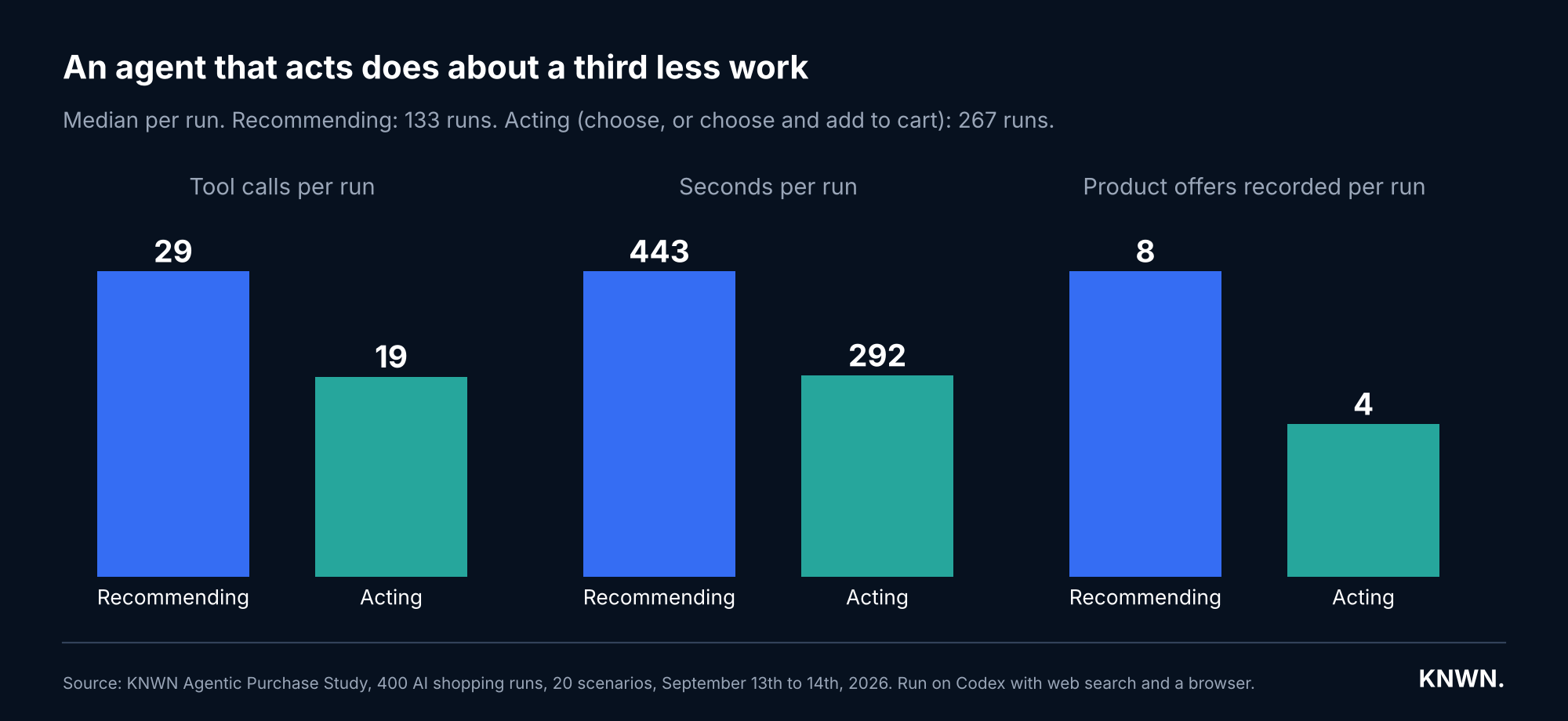
When an AI agent recommends, it explores the market. When it has to pick one product to buy, it does about a third less work and commits to the first option it can confirm. In the KNWN Agentic Purchase Study, that held in 19 of 20 scenarios.
TL;DR
- An agent that acts does less research. The median acting run made 19 tool calls against 29 for recommending, and it recorded half as many product offers (4 against 8).
- It narrows early and does not shop for the lowest price. The median price of its pick was $108.95 when recommending and $109.95 when acting.
- It stops at the first product it can verify. A page that shows the exact variant, a current price and stock gives it a reason to stop on your product.
Part 1 of this series found that the brand an agent recommends most is not always the brand it picks. In 25% of the scenarios we tested (5 of 20), a different brand won once the agent acted. This post looks at what changes in the way the agent works when it has to act.
We ran the KNWN Agentic Purchase Study on Codex, OpenAI's agent, with web search and a browser. It received the same 20 shopper requests 400 times. In 133 runs it recommended products. In 267 it acted on its own: it chose one product, or chose one and added it to a cart. Nothing was purchased. A tool call is any web search, page read or browser action.
An agent that acts does about a third less research
When an agent has to act, it stops building a list and starts confirming one product.
This happens because the job changes. Recommending asks for a set of good options, so the agent explores the market. Acting asks for one product that meets every requirement and can be bought, so the agent looks for a reason to stop.
The median acting run made 19 tool calls against 29 for recommending, which is 34% fewer. It also finished faster, in 292 seconds against 443.
The drop was not a quirk of a few categories. Acting runs made fewer tool calls in 19 of 20 scenarios. The exception was facial sunscreen, where the median acting run made 16 calls against 14.
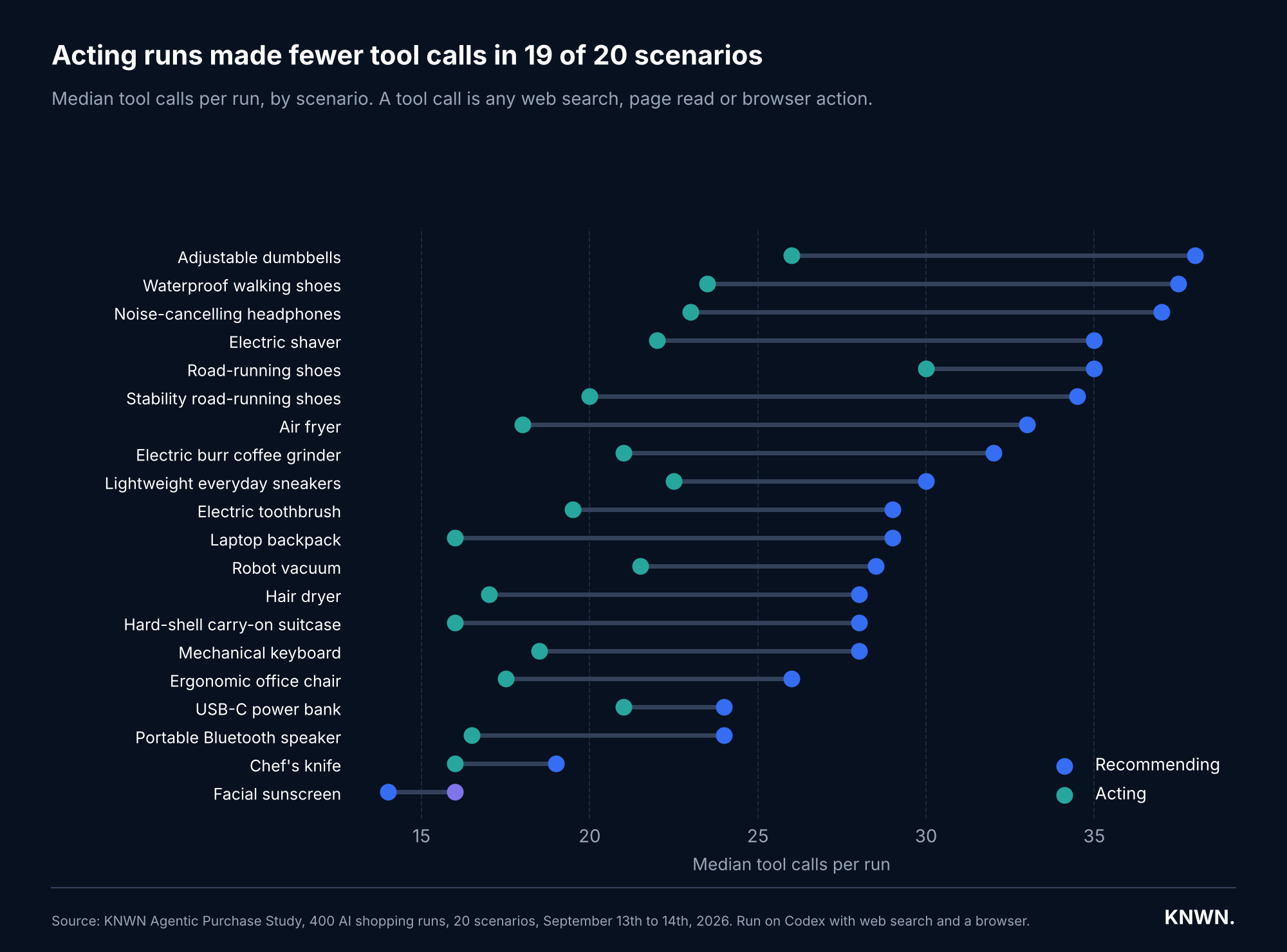
For a brand, this means the agent that decides to buy has read less about your category than the agent that recommends. Fewer pages are opened, so each page it does open carries more weight.
It records half as many options, and the pick is not cheaper
The agent narrows the field early, and the narrowing is not a search for the lowest price.
A recorded offer is a product listing the agent logged during its run. The median acting run recorded 4 offers against 8 when recommending, and it recorded fewer in all 20 scenarios. The agent did not trade down to save money. The median price of its pick was $108.95 when recommending and $109.95 when acting.
So the shorter list does not come from price pressure. It comes from the agent finding something it can verify and treating the rest as unnecessary.
It commits to the first option it can verify
Once an acting agent finds a product it can confirm, it usually stops looking.
We traced 82 choose runs step by step. In 61 of them, the agent ended on the brand of the first product it had labeled eligible. The first confirmed option was usually the final one.
The electric shaver scenario shows what that looks like. The request was for an electric shaver under $200 that is wet and dry and rechargeable. When recommending, the agent's top pick varied from run to run, and several times it led with the lowest-priced option it could verify. The median top pick cost $109.99. When acting, it picked the $179.99 Panasonic ARC5 in 13 of 14 runs.
Panasonic's own store showed the shaver in stock and linked a PDF manual, and the choose runs that picked it opened that manual to check the requirements. The cheaper options sat on retail pages the agent often could not load. In the choose runs, Best Buy failed on all 8 of its page loads. One run closed with this line: "The less expensive researched offers have unresolved current merchant availability."
The agent picked a shaver about $70 above the median top pick when recommending, because one page let it confirm everything in one place. That is how an acting agent decides: it takes the product it can verify over the product that may be better.
What does this mean for ecommerce teams?
A product page built for a shopper weighing ten options is being read by a buyer that checks one.
That buyer needs to confirm the exact variant, a current price and whether the item is in stock. It moves on if it cannot. We did not test changes to a store, so treat these as things to check on your own pages.
- Put the facts the buyer needs in readable text. Exact variant, current price and stock should be visible without a click, a selection or a login.
- Put the requirements in one place. The shaver that won had a manual the agent could open to check every requirement at once.
- Read one acting run from start to finish. Ask an AI agent to pick one product in your category, then read where it stopped and what it could and could not confirm.
Next week, Part 3 looks at why brands lose before the comparison starts: most losing brands were either never reached or could not be confirmed as buyable.
Get the full report
The full report covers all 20 scenarios and the method. Read the report at knwn.app/benchmark. If you want to see how an AI agent handles your store, talk to us.
Interpretation note: this article is educational material, not a product commitment or a guarantee of rankings, citations, traffic or commercial outcomes.